
FOR IMMEDIATE RELEASE
Supercritical Delivers Advanced Optimization Capabilities for Electra's NASA AACES 2050 Airliner Concept
Multidisciplinary design optimization from the University of Michigan spin-off enabled first-of-its-kind trajectory optimization with engine-cycle physics in the loop, making advanced electrified configurations possible to optimize as whole systems.
Ann Arbor, MI · July 14, 2026
Download release (.pdf)Supercritical Inc. announced its role in developing advanced multidisciplinary design optimization capabilities for Electra's next-generation turbo-electric airliner concept, created as part of NASA's Advanced Aircraft Concepts for Environmental Sustainability (AACES) 2050 program.
Supercritical, a University of Michigan spin-off specializing in high-fidelity multidisciplinary design optimization (MDO), built key components of the optimization machinery that allowed the Electra-led team to evaluate unconventional aircraft as fully integrated systems using coupled physics-based models.
The work supports Electra's broader view that electrification is not only a propulsion shift, but a way to unlock new aircraft architectures by allowing airframe, propulsion, thermal, and mission design to be optimized together.
The Electra AACES 2050 concept pairs a double-bubble lifting fuselage with hybrid-electric propulsion including boundary-layer-ingesting electric tail fans, a configuration the team found could deliver up to a 17 percent efficiency improvement beyond gains already expected by 2050. Concepts of this kind are challenging to evaluate with conventional conceptual design tools because the airframe, propulsion, and thermal systems are too tightly coupled to be studied in isolation. Supercritical contributed key framework integration capabilities that enabled the broader team to evaluate these tightly coupled systems within a unified optimization framework.
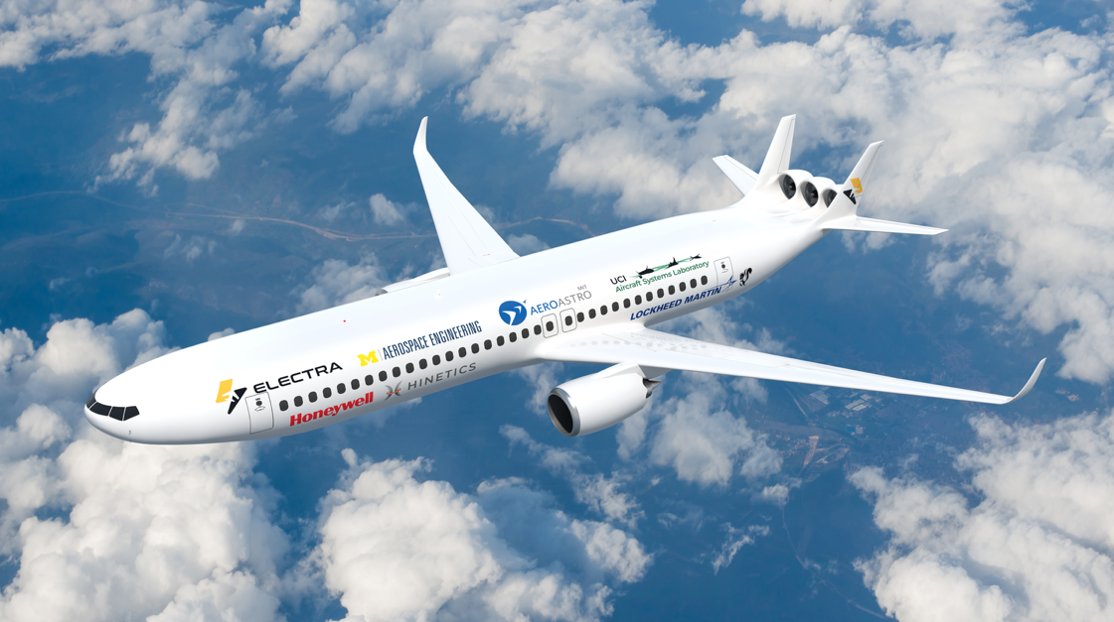
Electra's AACES 2050 turbo-electric airliner concept, featuring a double-bubble lifting fuselage and boundary-layer-ingesting electric tail fans.
Credit: Electra.
Supercritical was a key collaborator on our AACES program, providing deep system modeling and MDAO integration support that enhanced the fidelity of the design framework and, ultimately, the quality of the concept aircraft.
Director of Product Strategy, Electra
A key contribution of the collaboration was the development of an engine-cycle trajectory optimization capability. MIT's Gas Turbine Laboratory led the development of the robust propulsion-cycle modeling needed to evaluate a full engine thermodynamic cycle at every point along the mission, while Supercritical contributed to integrating these capabilities within the broader multidisciplinary optimization framework. This replaces the lookup tables and surrogate models that conceptual studies typically rely on, allowing real propulsion physics to remain directly coupled to the optimization of both the aircraft design and mission trajectory. Achieving this level of integration is a challenging numerical problem that has not previously been demonstrated at this scale within an aircraft design framework.
Co-optimization of an aircraft propulsion design, thermal system design, and mission trajectory path is an extremely challenging problem with potentially thousands of design variables and constraints. Historically, the aircraft industry has designed these components separately. For years, NASA has been developing tools and methods to support a foundational transformation of industrial aircraft design. Supercritical and Electra's work has further built upon these tools, demonstrating industrial adoption which is critical to maintain the US lead in aeronautics.
Research Aerospace Technologist, NASA
Beyond the trajectory work, Supercritical brought empennage sizing into the optimization itself, sizing tails for demanding engine-out conditions to maintain aircraft control across conventional, distributed, and hybrid-electric layouts, rather than treating them as fixed inputs. They contributed structural weight modeling for unconventional double-bubble airframes, extended the framework to hybrid-electric propulsion with motor, inverter, battery, and thermal trade-offs, integrating these capabilities natively into NASA's open-source Aviary framework, built on OpenMDAO. Throughout, Supercritical turned research prototypes into reliable, analytically differentiated, framework-ready capabilities a design team can trust across thousands of optimizations.
Automated optimization of tightly coupled aircraft systems has mostly stayed inside academic research. We founded Supercritical to put it in industry's hands. AACES shows the result: we can take aviation's most challenging coupled design problems and turn them into optimizations a team can actually run.
Co-founder, Supercritical Inc.; Director, University of Michigan MDO Lab
The capabilities developed through the collaboration are being contributed back to the community. Much of the work extends NASA's open-source Aviary framework and is planned for public release, giving researchers, students, and industry teams the same tools to evaluate advanced aircraft concepts with greater rigor and reproducibility.
The collaboration also created a rich learning environment by bringing together complementary expertise in propulsion modeling and multidisciplinary design optimization. MIT SM student Anushka Tahiliani, advised by Prof. Masha Folk at the MIT Gas Turbine Laboratory, worked with Supercritical's Andrew Lamkin to combine advanced propulsion-cycle modeling with high-fidelity MDO, enabling the engine-cycle trajectory optimization capability within the AACES design framework. Their paper, “Robust Approach to Engine Cycle Modeling to Enable Multidisciplinary Optimization of Advanced Aircraft,” received First Prize in the 2026 AIAA AVIATION Forum MDO Student Paper Competition.
About Supercritical Inc.
Supercritical Inc. is a University of Michigan spin-off providing high-fidelity multidisciplinary design optimization software and engineering services for advanced aircraft. The company specializes in gradient-based aerodynamic, aerostructural, and aeropropulsive optimization built on the open-source OpenMDAO and Aviary frameworks, helping aerospace organizations design and evaluate advanced configurations faster and with more confidence. Supercritical was co-founded by Professor Joaquim R. R. A. Martins, director of the University of Michigan's MDO Lab, Dr. Anil Yildirim, and Dr. Andrew Lamkin.
About Electra
Electra.aero, Inc. (Electra) is an advanced air mobility (AAM) company building hybrid-electric Ultra Short airplanes that deliver unprecedented performance advantages to fly people and cargo seamlessly without airports, emissions, or noise. With the EL9 Ultra Short, Electra is pioneering Direct Aviation, the next level of connectivity that brings air travel closer to where we live, work, and play. Electra's Ultra Short technology delivers 2.5x the payload and 10x longer range with 70% lower operating costs than helicopters and eVTOLs with significantly greater safety and far less certification risk.
Electra's team includes some of the most respected and successful entrepreneurs and engineers in novel aircraft design, with over 40 prior aircraft successfully developed and/or certified. Lockheed Martin Ventures, Honeywell, and Safran are among Electra's strategic investors along with Prysm Capital, the Virginia Innovation Partnership Corporation (VIPC), and other private investors. Electra's contracted customers include the U.S. Air Force, the U.S. Army, the U.S. Navy, and NASA along with over 2,200 letters of intent from 60+ commercial customers, including both airlines and helicopter operators.
Ready to solve your engineering challenges?
Contact our team of experts today to discuss your specific needs.
GET IN TOUCHGlobal pioneers in computational design optimization, we offer breakthrough engineering solutions backed by exceptional research and industry-leading expertise.
Services
© 2025 - 2026 Supercritical Inc. All rights reserved.